
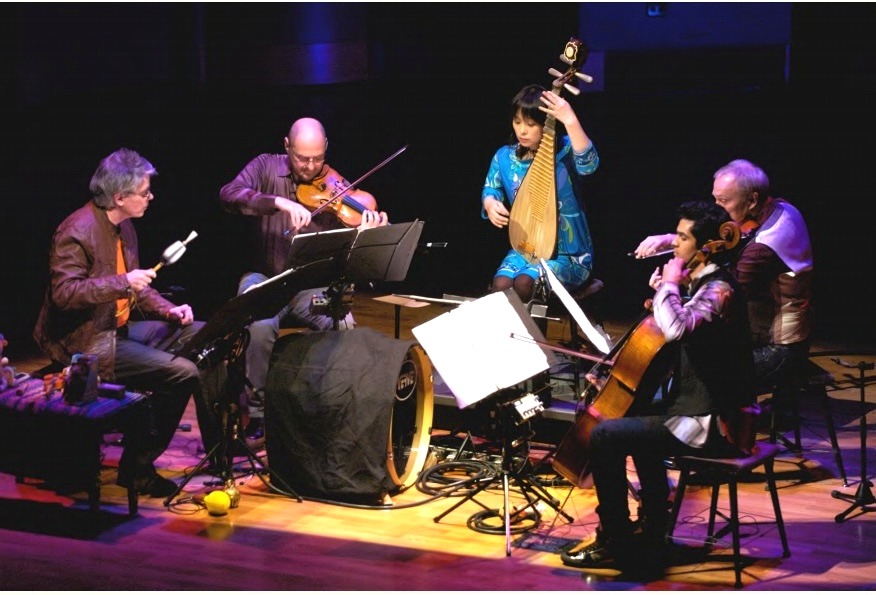
Photos courtesy of Wu Man.
English Version
Introduction
In February 2023, the United States’ National Endowment for the Arts (NEA) announced the recipients of its 2023 National Heritage Fellowships, the nation’s highest honor in folk and traditional arts. Among them was pipa virtuoso Wu Man, a musician who has brought the ancient sound of the pipa to North America and into global consciousness.
How does she perceive the differences between Eastern and Western musical traditions? And within those differences, how does she search for her own artistic identity—becoming both a bearer and an advocate of cultural heritage? Prompted by these questions, Kui Dong, acclaimed composer and professor of music composition at Dartmouth College, and distinguished Chinese American musician Hong Wang, longtime friends in the international music community, reunited with Wu Man for a thoughtful dialogue on the pipa, on music, and on the art of living.
On Musical Transmission: The Subtle Flavor Within Technique
Kui Dong: I know you’ve collaborated with musicians from various countries along the Silk Road, and you’ve also performed many contemporary works, like those by Tan Dun and Zhou Long. As a performer, how is working with Silk Road musicians different from playing contemporary compositions?
Wu Man: I’ve played in a lot of ensembles, including the Aga Khan Master Musicians in Europe. The group is made up of artists from Silk Road countries, and we play traditional instruments from our respective cultures. There are no Western classical instruments involved. That has been an incredibly nourishing musical experience for me.
As for contemporary works, I was exposed to them during my student years. I performed new pieces by composers like Zhou Long and Guo Wenjing, where we used traditional instruments to interpret contemporary compositions, rather than playing ancient pipa scores passed down through generations or pipa pieces shaped by the cultural and political themes of the 1960s.
Actually, I think the essence of music is fundamentally the same across different traditions. The material behind each piece often comes from the composer’s own cultural background, their evolving understanding and knowledge of music, and the musical nourishment they’ve received throughout their lives. It’s the same for Kui Dong, of course.
Some composers might begin with the melody of a folk song. Others might draw from poetic imagery rooted in Chinese aesthetics or philosophical ideas. Some are deeply influenced by the guqin tradition, while others may find inspiration in music from different Asian cultures. In fact, this is a common thread. These musical creations grow from something deeper and real. We can’t just invent them from nothing.
In short, everything traces back to our ancestors.
Hong Wang: What Wu Man just said really resonated with me. The traditional music we know today, in many ways, comes from each person’s own cultural background. In the past, it was hard for court music to survive over time, simply because ordinary people had no access to it. It remained within palace walls and never became part of the public’s musical life. What we now refer to as “folk” or “ethnic” music is essentially traditional music that has continued to be played among the people.
A piece like Jasmine Flower, for instance, exists in numerous versions—sometimes even under different names. Folk musicians often rely on oral formulas or mnemonic phrases to guide their performance and even composition. But they may not recognize these as a kind of music theory. It takes trained musicians to identify, analyze, and formalize this knowledge. Take something like “the fish bites its tail”—it’s a vivid, image-based way of describing a musical structure or motif.
So when we talk about musical heritage, the real question is: how do we preserve these traditions? And how do we ensure they continue to grow and evolve? As Wu Man just described, her work embodies the transmission of musical heritage.
Kui Dong: Hong Wang just used the term “transmission.” Wu Man, would you say what you're doing is more about transmission, or dissemination?
Wu Man: I think it’s both. A musician cannot disseminate something unless they have first received something to pass on. So transmission and dissemination can go hand in hand.
Just now, Professor Wang mentioned the relationship between traditional music, folk music, and contemporary works. I think folk music often carries strong regional characteristics. For the people, the music they know and resonate with is shaped by the land they live on. For instance, the musical expressions in Syria are distinct from those in Iran. Even though they may all draw from the Muqam tradition, musicians from Afghanistan and Iran will interpret the same scale differently. Still, they operate within a shared framework and musical philosophy, and use a small set of tones as raw material to create endless variations. Sometimes just three notes can develop into an hour of music. That’s the skill of the performer, and it’s also a kind of creation.
This kind of creation is not fixed; it’s constantly evolving. Every performer brings their own experience, life story, abilities, and intuition into the music. The same person may even play something differently from one day to the next. That’s the essence of music—an act of invention that reflects human intelligence and creativity.
Another example is Jiangnan sizhu. People in Xi’an may not be familiar with it, just as people in Shanghai may not know Xi’an drum music. Each has its own distinct local musical language. Jiangnan music embodies the softness and subtlety of the Wu dialect, while Xi’an drum music reflects the city's direct and forthright character. Its bold, unembellished sounds take a very different path compared to the more delicate "flavors" of Jiangnan sizhu.
These traditions have been passed down naturally from generation to generation. And when we take these regional styles and characteristics and embed them in contemporary works, letting modern audiences experience them, I believe that’s also a kind of transmission.
At the same time, it’s dissemination: people come to recognize that a certain flavor comes from Jiangnan sizhu, or another from Xi’an drum music. These traditional elements find new life in contemporary compositions, allowing future generations to hear echoes of the past. The methods and mediums may differ, but transmission and dissemination are not in conflict. They complement each other.
Hong Wang: When we talk about transmission, I think back to learning the erhu from a traditional Chinese opera musician as a child. My teacher, Lu Xiaojie, is now in his seventies and still teaches the erhu. Over the years, he has codified many erhu techniques from traditional Chinese opera that can be passed down. One example is what he calls the “ying” technique, which describes how the player smoothly leads into the singer’s line—how to “meet” the voice with the instrument.
I also had the chance to learn from Gan Tao, a respected elder of Jiangnan sizhu, who authored a book titled Jiangnan Sizhu Music. For the same qupai (titled tune), the scores are all written in skeleton notation, but the rhythmic structures differ. Some are 48 beats, others over 70. And although the written scores may be similar, the interpretive techniques used by musicians of earlier generations could vary significantly, producing entirely different musical effects.
What we’re transmitting, really, is not just the written score or different versions of it, but a living technique. Where do these techniques live? In the performance—should a certain note be played with an upward or downward slide? Even when the score only shows the skeleton notation, a performer can bring out the distinct flavor of Jiangnan sizhu through their interpretive choices.
When I studied with my teacher, he often practiced what he called “non-teaching.” That is, he wouldn’t give direct instructions. Instead, he’d ask me to pull up a stool and sit beside him, simply listening to the flavor within the techniques as he played. That kind of living transmission is exactly what’s missing from much of today’s music education.
Wu Man: This is actually a rather complex process. What exactly are we transmitting, and how is it transmitted? Even with the same score, different performers will inevitably interpret it differently.
Take pipa tradition, for example. I studied pipa during my graduate years with Mr. Lin Shicheng, a master of the Pudong school. He was a disciple of Shen Haochu and Ju Shilin. The versions of Shen and Ju’s scores we play today were all edited by Mr. Lin based on his own understanding of the Pudong school. In that sense, what we are learning is really Mr. Lin’s interpretation, and we don’t actually know what Mr. Shen’s or Mr. Ju’s music truly sounded like.
So when we talk about "transmitting something," the core question becomes: what is the essence of the Pudong school that we are transmitting? That’s what we’re trying to preserve. Of course, if Mr. Lin’s fellow disciples also passed on the same scores from Mr. Shen, their interpretations might differ yet again. That’s what makes it all so fascinating.
The so-called "school" (liupai) in Chinese music largely emerged because transportation was limited in the past, and musicians couldn’t communicate with each other easily. One village might play Ambush from Ten Sides a certain way, and another village would do it a little differently. As Hong Wang mentioned earlier, the score may contain only the skeletal framework, but interpretation is deeply personal.
What we now call "schools" of pipa playing are really different approaches to interpreting the same work. Some schools emphasize intricate detail and subtle nuance, while others prioritize boldness and long, flowing lines. Each technique carries a certain flavor unique to that tradition. That’s the heart of musical transmission.
On Collaboration: Finding the Self Through Dialogue
Dong Kui: I have a question for you, Wu Man. As a pipa player, you could have devoted yourself fully to understanding and carrying forward Mr. Lin’s teachings, promoting the Pudong school. But instead, you chose to collaborate with musicians from many other countries and regions. Why?
Wu Man: I am carrying forward the Pudong school tradition. I’ve performed many works from that school—I haven’t abandoned it. But I don’t see myself as belonging only to the Pudong school. I love and study elements from all the major pipa traditions. Sometimes I’ll compare scores from two different schools for the same piece, and it’s fascinating how differently they interpret it. By absorbing all these “nutrients,” they eventually become part of your own expression, though the essence of the Pudong school still remains in what I do.
Working with Central Asian musicians, for instance, I’ve been deeply moved by their music. There’s a resonance there. A lot of what they play can’t be captured through notation—it lives in the subtle inflections, the microtones between notes, like a raised fa that’s not quite fully raised. You have to listen for those micro bends and delicate flavors. I find their music incredibly enjoyable. They might be playing from the same score, but each performance is entirely their own.
Learning from them has made me reflect on our own folk traditions. Aren’t we like that, too? Take a piece like Moonlit Night on the Spring River—I try to make each performance of it different. As a performer, this broadens your mindset. When you return to traditional repertoire or interpret a composer’s work, you come at it with new insights and perspectives. These are things I’ve learned through collaboration. I immersed myself in other musical traditions and learned from the folk spirit within them.
Dong Kui: I really appreciate your perspective, because many performers aren’t necessarily willing to learn from folk traditions. When you heard those tiny bends and subtle inflections in Central Asian music, did you find any similarities when you reflected on Chinese music? Or did they feel completely different?
Wu Man: Oh, incredibly similar! And it’s the kind of similarity that excites you. It’s not that the scales are the same, but the expressive techniques—the flavor and nuance—feel so familiar. Not long ago, I was in Canada for a seminar and learned some new pieces—Arabic music, muqam, and so on, arranged by musicians themselves. When I heard them play, it immediately reminded me of the erhu, of Jiangnan sizhu. That same delicate inflection—it’s all there.
In Chinese music, we call it jiahua bianzou—embellished variations. And that’s exactly what you find in Central Asian and Arabic music too. Just like in Jiangnan sizhu, each person can create their own variation, and no two performances are ever the same.
So in the end, human responses to music and our ways of thinking about it are remarkably similar.
Dong Kui: We’re all pursuing a kind of free expression.
Wu Man: Yes, and as we said earlier, it’s freedom within a framework. This isn’t something unique to Chinese music—it’s common to many musical cultures along the Silk Road, and even in European folk traditions. Folk songs, too, were originally improvised. Even composers like Chopin built on improvisation. The only difference is that it got written down.
That’s why, when we study Chinese music, it helps to look beyond ourselves and toward the surrounding cultures. Once you see the connections, you stop obsessing over what’s “uniquely ours.” You realize there’s a bigger, richer world out there.
Dong Kui: There’s a strong similarity.
Both of you have worked with contemporary composers and Western ensembles. A challenge I often encounter is this: when Chinese traditional instruments are combined with Western ones, there’s always a rhythmic mismatch. The two traditions are not consistent in rhythm.
Compared to Western music, Chinese music is primarily melody-focused. The structure is sectional; it moves in phrases rather than continuous development like in Western classical music. Whether folk or classical, Chinese music tends to appear in distinct sections.
So here’s my question: what exactly is rhythm in Chinese music? And when you collaborated with Western orchestras, did you have to make significant adjustments?
Wu Man: From the perspective of traditional music, Han Chinese rhythms aren’t very complex. The rhythms are strictly structured and consistent, without much variation. Most pipa scores are in duple or quadruple meter, or in free rhythm (sanban). Triple meter is quite rare in Han music. I remember that back in Confucius’s time, if you changed the meter, it was considered improper and lost its elegance. The Han people have their own aesthetic theory.
But South American music is all about rhythm. Much of it is performed outdoors, where people need to move and dance. Everything centers on rhythm, which can be very complex. Their strong beats aren’t the kind we’re used to. Han people rarely dance, though some ethnic minorities like the Uyghurs and Kazakhs have more complex rhythms and are good at dancing.
When collaborating with Central Asian musicians, I recall the rhythms of Uzbek musicians—every bar and phrase constantly shifts. Their rhythmic accents often land unexpectedly, coming later than we’re used to, which is closely tied to their dance and body movements. It’s a real challenge, but over time, we come to accept it.
Another experience is playing pieces composed for orchestras or chamber ensembles. Here, you have to consider the bigger picture. For example, in one passage you might be the lead, while in another you support others. Sometimes the composer’s designs are complex, but this complexity isn’t the same as the physical rhythmic complexity I mentioned earlier. It’s a complexity born of deliberate composition. Many rhythms are not naturally spontaneous but carefully crafted. This requires learning and rehearsal. Performers have to find their roles, and when everyone blends, it creates a unified sound—a story. Musicians must develop this ability to enable diverse musical expressions.
Ms. Dong just mentioned that Chinese music tends to be melodically single-lined. This is also true for Japan, India, Iran, and Central Asia—mostly melody-based traditions. That’s why there are so many ornaments and embellishments, which is what we call yunwei (subtle flavor). It’s a deeply nuanced experience. Western music, on the other hand, is driven by harmony and is more straightforward. For instance, the piano is a harmonic instrument. But our music can’t be expressed just by plain notes—it requires these subtle “flavors.” I believe both harmonic systems and linear melodic systems are human ways of emotional expression. We need and love them all, and neither can be replaced.
Hong Wang: That’s a great summary, Ms. Wu. For example, the guqin’s jianzipu (a traditional reduced-character notation) shows which pitches to play but provides no rhythmic information. Everyone plays it differently. Our traditional music gives performers space to express themselves. The rhythm is a common framework that allows individual interpretation.
Wu Man: From the perspective of cultural heritage, Confucius has indeed had a profound influence on us.
Dong Kui: I recently released an album of my compositions, published by KAIROS Records in Austria. After listening to it, Dutch musicologist Frank Kouwenhoven told me, “I think you're an American composer. Two of the pieces sound very American, the third feels a bit German, and the fourth—I have no idea where it comes from.”
I said to him, “You’ve said all that, but never mentioned China.” I could tell that, in his view, my music didn’t sound particularly “Chinese,” perhaps because it wasn’t heavily influenced by folk music. But from my own perspective, the influence is there—just not in a direct way. I only went abroad when I was 23, so my early education was entirely in China.
Frank also told me he has a composer friend who believes all Chinese composers must include something Chinese in their work. Frank disagrees with that idea. I told him I was glad to hear that, because honestly, I still don’t know who I really am. He laughed and said, “Well, you’re constantly searching for who you are. That in itself is a powerful driving force—that’s actually a great source of creative energy.”
Everyone knows that Frank is a Western scholar who studies Chinese music. He once said that it was only after spending time in China that he truly understood what Dutch culture meant.
So, Ms. Wu, now that you’ve been collaborating with musicians from many different countries, what reflections have come out of that process for you?
Wu Man: First of all, this has always been a personal wish of mine: to bring the pipa onto the international stage through collaboration. That’s something I’m committed to, without a doubt. But it was only after working with others that I began to really understand Chinese music. Hearing music from so many different cultures made me reflect deeply, and I realized that there’s something so distinctive and expressive about Chinese music. It resonated with me in a way I hadn’t expected. That essence was already in my blood—I just hadn’t been fully aware of it.
To me, your music, Ms. Dong, sounds very Chinese. Your thinking, your approach to structure—they’re rooted in Chinese tradition and very different from how Western composers think. Even though your works don’t use folk melodies directly, the concepts and the way you think musically are unmistakably Chinese. These things often become part of you subconsciously. My own experience has been the same. You walk around the world, and only when you return to where you started do you truly see it. That’s when you realize what kind of character your instrument has—what kind of voice, what kind of language it carries.
Sometimes it takes stepping outside to really see clearly.
Hong Wang: It was only after doing fieldwork that I realized how incredibly hard it is for someone unfamiliar with a culture to truly grasp a traditional music—whether it’s from an ethnic minority or the Han majority. Music is inseparable from culture, including its rhythms. Take the Mongolian court piece The Wind from Heaven as an example. It wasn’t until after collecting the material that I discovered it’s in five beats—a courtly rhythm closely tied to dance movements.
I once collaborated on a project in Beijing that combined twelve pieces of Latin and Cantonese music. It was extremely challenging. In traditional Chinese music, the rhythm is often steady and regular, but the melody tends to be free and improvisational. Latin music, on the other hand, is strongly rhythm-driven and closely tied to dance. So, any collaboration requires both sides to adapt. Through that process, I came to better understand what makes our own musical traditions so unique and brilliant.
On Experience: Does Fusion Lead to Loss of Identity?
Dong Kui: Over the past 30 years, we’ve experienced globalization. But it’s quite possible that after such constant openness, people suddenly realize that in the process of fusion, “the self” is lost. Is this a natural evolution, or a regression?
Wu Man: This is a common viewpoint, but I must disagree. For musicians, fusion is only one part of the picture. Tradition is the prerequisite for fusion. You have to express your own character within the process of fusion.
Many people think that overseas musicians lose their tradition, but I actually feel the opposite. Many overseas musicians learned the essence of tradition when their senior masters in China were still alive. Many excellent performers in China brought these traditions abroad, like an “old fashion.” They have preserved tradition, and through dialogue with the world, they better understand what tradition really is.
I’m actually quite worried about the current loss of tradition. When we were learning, the masters taught face-to-face, orally and from the heart. Now, young people mostly learn from adapted scores, and many ancient pieces are being forgotten. Once the old masters are gone, the tradition is lost. The idea that overseas musicians have “lost tradition” is a misunderstanding.
Take Ang Lee’s films, for example. They’re full of the temperament of Chinese literati—more Chinese and traditional, with richer Chinese aesthetics than many mainland Chinese movies. Because he has seen the world, he has found his own place.
What Mr. Dong just said about globalization is important: at the artistic level, it must be a cooperative relationship. There is “you” in me and “me” in you. But cooperation doesn’t necessarily mean losing tradition, because these traditions are in our blood.
Dong Kui: What expectations do you have for young performers?
Wu Man: Young people are certainly smart and talented, but it’s very important to have a broader view of the world—to avoid thinking within a small circle. You have to be tolerant and learn from others’ strengths. That’s the only way to progress. It’s important to engage with new ideas and with the whole world. Seeing the world is crucial! That’s been my own experience.
It’s the 21st century, and the whole environment is different now. No one used to imagine the pipa collaborating with a string quartet.
Of course, my experience is personal. I’m not saying all students must study abroad, but once you leave campus, China is vast and rich in musical character and cultural depth.
Dong Kui: That’s right. Music is a life experience, and teachers can’t really teach that. I’m a composer, but I don’t particularly enjoy teaching composition now. It’s hard to teach.
Wu Man: I remember reading an article about a 1960s student exhibition at the Central Academy of Fine Arts (CAFA), where each student wrote down one sentence about what they remembered most from their teachers’ lessons. Most recalled life inspirations from their teachers.
In music education, the teacher’s role is not just to show students where to place their fingers or how to play the notes. It’s very important for students to see the world and accumulate life experiences. That’s what truly inspires and transforms you.
Hong Wang: I greatly admire overseas musicians like Wu Man and Wu Wei. They excel in their professional fields, seize opportunities, and gain cultural influence. Only then can Chinese traditional music and contemporary Chinese music express their character in fusion with Western music.
Interviewee —
Wu Man: Pipa performer, Distinguished Professor at Zhejiang Conservatory of Music, Honorary Doctorate from the New England Conservatory.
Originally published in Music Culture Studies, No. 1, 2024, pp. 39–46.
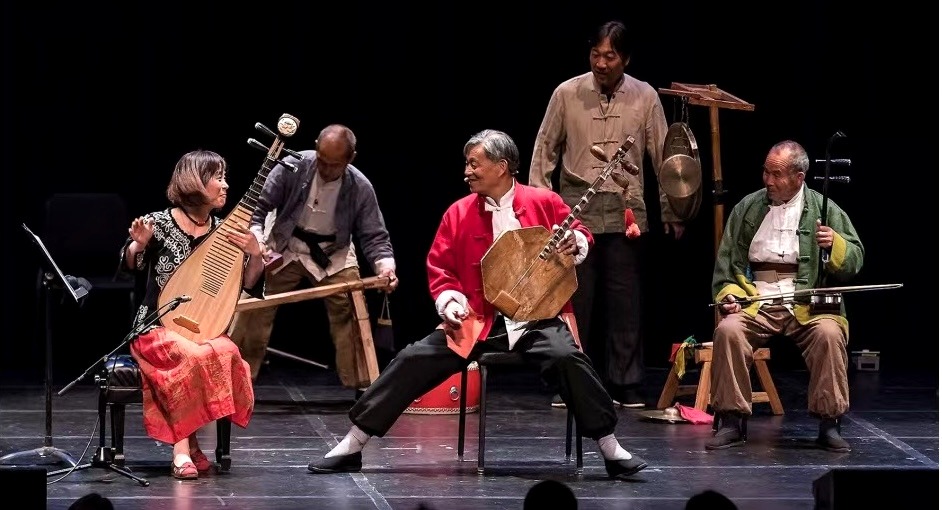
Photos courtesy of Wu Man.
中文原文
整理撰稿:臧娜
2023年2月美国国家艺术基金会(NEA)公布了2023年国家传统艺术遗产奖名单,是民间和传统艺术方面的最高荣誉,琵琶演奏家吴蛮位列其中,这位将古老琵琶音乐带到北美、走进世界观众心中的音乐家,如何看待音乐艺术的东西方差异,又如何在其中探寻自我,成为文化传统的传承和传播者。带着这些问题,美国达特茅斯学院终身作曲教授董夔、知名华裔音乐家汪洪,海外音乐圈的一席老友与吴蛮重聚,一起谈琵琶,聊音乐,品人生。
谈传承:技法里藏着味道
董夔:我知道吴蛮老师和从丝绸之路各个国家来的音乐家都合作过,同时你也演奏过很多现代作品,比如谭盾、周龙的作品,等等。从演奏家的角度来讲,你认为跟丝绸之路各国音乐家合作,与演奏创作音乐相比,有什么不一样的地方呢?
吴蛮:我参加过很多乐团,比如欧洲的阿贾罕(AgaKhan)音乐大师团,里面都是来自丝绸之路国家的音乐家,演奏的是各个国家的民族乐器,没有西洋古典乐器,给了我很多音乐营养。关于现代作品,我在音乐学院做学生的时候,就已经开始涉猎到现代作品了,比如周龙、郭文景的作品,就是用传统乐器演奏现在人写的作品,而不是弹奏古时候传下来的琵琶谱,或者是60年代用歌曲改编的琵琶谱。
其实,我觉得音乐的本质是一样的。这些音乐本身的素材其实都是来自于各自的传统,来自作曲者的背景,还有从小他们对音乐的认知和知识,自己自身的音乐养料,董夔老师也是一样的。有的人可能就是用一首民歌的旋律来创作,有的可能从中国的美学、哲学思想中吸收了那种意境美,有的吸收了很多古琴的东西,甚至亚洲其他国家的创作也通此理。这些音乐创作不是凭空来的,没有办法编造。
一句话,都是祖先传下来的。
汪洪:刚才吴蛮老师说得很好,我们所认知的传统音乐都来自于每个人自己的文化背景。比如过去的宫廷音乐为什么很难流传不下来,因为老百姓没有权利享受那些音乐,只在宫廷里面流传。现在我们讲的⺠族⺠间音乐,实际上就是在老百姓当中还在演奏的传统音乐。一个《茉莉花》就有很多的版本,甚至不同的名字。⺠间音乐家也有一些口诀来用于创作和演奏,但是他们没有意识到这是一种音乐理论,需要有懂专业的音乐人去总结。比如⻥咬尾,这类用比较形象的语言来形容音乐创作的语汇。所以我们要讨论音乐的传承,怎样把这些传统的东⻄留存下来,怎么去发扬光大。
吴蛮刚才说她现在做的事情,实际上是一个传承传统的过程。
董夔:汪老师用了“传承”这个词。吴蛮老师,请问你认为你所做的是“传承”还是“传播”呢?
吴蛮:我觉得两者都有,音乐家如果没有传承而来的东西,就不可能传播,两者是相互的。刚才汪老师提到传统音乐、民间音乐和创作音乐的关系。我觉得民间音乐有很多地方特色,对老百姓来说,可能他们生活在哪块土地上,就熟悉那种音乐表达。比如在叙利亚就是这样的音乐表达,在伊朗就是那样的一种音乐表达,虽然它们都是根据木卡姆(Muqam)的音乐形式传承的,可同样一条音阶,阿富汗人和伊朗人演奏起来就不一样。但基本上它们都在一种框架里面,在同一种理念里面,只是用这几个音作为素材,不断变化。只有三个音,但是能变化出一个钟头的音乐,这就是演奏家的本事,也是一种创作。这种创作是不固定的,每个人根据自己的经验、经历、能力、智慧,演奏出来都不同,甚至同一个人每一天演奏出来都不一样,这就是音乐的精髓,一种创造活动,体现了人的聪明和智慧。
再比如,江南丝竹,西安人肯定不熟悉;西安人的鼓乐,上海人也不熟悉,他们有各自的地方语言特色。江南音乐有吴侬软语的特色,西安鼓乐有西安人性格中很直爽的东西。西安鼓乐中有一些很大气直接的声音,拐弯拐得跟江南丝竹不一样,“小韵味儿”不同。这种东西是一代一代自然传承下来的,如果说在创作音乐中直接拿过来,把这种风格和特点放在新的音乐里面,让现代人去感受,我觉得其实也是一种传承。同时,也是一种传播,大家会知道这个是来自江南丝竹,那个是来自西安鼓乐,通过创作成为一个新的作品,让下一代人听见传统的东西。只是途径和手段不同,我觉得“传承”和“传播”互相不矛盾。
汪洪:所谓“传承”,我从小是跟戏曲老师学的二胡。我的老师叫卢小杰,已经70多了,至今依然在做戏曲胡琴的教学。他总结了很多可以传承下来的戏曲胡琴演奏技法,比如他总结的几十种演奏技法中的“迎”字,就是拉琴的琴师怎么跟演唱者自然衔接,“迎”上去。我也接触过江南丝竹的老前辈甘涛老师,他写过《江南丝竹音乐》一书,同样曲牌的作品全是⻣干音记谱,只是板式不一样,有的是48板,有的是50几板,甚至到了70几板,但过 去前辈音乐家在演奏上的技法处理是不同的,演奏效果也各不相同。
实际上,我们传承的不仅仅是各个版本的乐谱,而是活着的技法,这些技法在哪里使用呢?比如某个音要用上滑音还是下滑音,后人看到⻣干音的乐谱,也可以用不同的方式来演绎,演奏出来的就是江南丝竹的味道。我的老师在教琴的时候常常是“不教”的,所谓“不教”,就是让我搬一把凳子坐在边上,他拉你听,听演奏技法里面的那种味道。我们目 前的音乐教育欠缺的也是这种传承意义上的活的东⻄。
吴蛮:这其实还是一个很复杂的过程,比如如何传,传什么。同样一个谱子,每个人演奏出来还不一样。
比如琵琶传承,我是研究生时期跟林石城先生学的琵琶,他是浦东派,林先生应该师从沈浩初、鞠士林先生的学生。目前我们学习演奏的沈浩初、鞠士林先生谱,其实都是林先生根据他对浦东派的理解整理出来的,已经成为林先生自己的东西,我们其实不知道沈浩初、鞠士林先生的音乐是什么样。所以,怎么传,要传浦东派的精髓,也就是它的特点是什么。我觉得这就是一种“传”。当然,如果林石城有师兄弟,同样传承沈浩初的谱子,可能又不一样了。所以我觉得这是非常“妙”的一个东西,很有意思。
中国音乐所谓的“流派”,是因为当时交通不发达无法频繁交流的缘故而产生的,这个村这样演奏《十面埋伏》,到了那个村又有点不一样了,这是李家和王家的区别。就像刚才汪洪老师说的,如果研究乐谱,就都是骨干音,只不过每个人的诠释不同,是非常个人化的。现在所谓的琵琶流派,其实都是对乐谱的诠释不一样,有的派别很细碎,讲究小味;有的派别比较大气,讲究线条。这些技法里边藏着不同的味道,也就是它的特点,这是传承的精髓。
谈协作:对话中认识自我
董夔:我有一个问题想问吴老师。你是一个琵琶演奏家,你完全可以去理解和继承林先生的教导,把浦东派的琵琶演奏发扬光大。可你为什么没有这么做,而去跟更多其他国家和地区的音乐家合作。
吴蛮:我在传承浦东派的东西,演奏了很多曲目,并没有丢失啊。但我不仅仅是浦东派的,所有跟琵琶音乐流派相关的东西我都喜爱和学习。我有时候把两个不同流派的琵琶谱拿出来对比,他们对同一首曲子的处理方法各不相同,很有意思。这样我就吸收到了各种“营养”,最后变成你自己的,但是浦东派的精髓还在。
在跟中亚音乐家合作的过程中,我觉得他们的音乐让我感动,有共鸣。他们音乐中很多内容不可能靠记谱记下来,必须要去聆听里面的小味儿、小弯儿,比如升fa又不到升fa,在两个音之间的“韵味”。听他们的音乐我很享受。还有,同样的乐谱,他们每奏一遍也都会不一样,我在学习他们的过程中,也会反思我们自己民间的东西,是不是也是这样?比如,一首《春江花月夜》,我可以做到每一次的演奏都不相同。这样,作为一个演奏家,你的思路就宽阔很多,你再去演奏传统曲目或作曲家的作品,你的看法和理解的角度就会不一样。这些都是在跟其他国家音乐家合作的过程中,从民间学到的。
董夔:我很喜欢你的想法,因为很多演奏家未必真的愿意从⺠间去学习。请问你在中亚音乐家那里听到的那个“小味儿、小弯儿”,当你回想到中国音乐的时候,发现有什么相同之处了吗?还是觉得非常不一样?
吴蛮:太相同啦!让你觉得很兴奋的那种相同,不是说音阶相同,而是说那种表达手法、韵味相同。前段时间我去加拿大参加一个研讨会,新学了一些曲子,比如阿拉伯音乐、木卡姆等等,都是音乐家自己改编的。我一听他们拉这些曲子,就想到了二胡,想到我们的江南丝竹,那种小味儿,都是一样的。我们在音乐中叫加花变奏,其实中亚音乐、阿拉伯音乐全都是加花变奏(variation),就像我们的江南丝竹一样,每个人都可以来一段加花变奏,而且每个人的每一次演奏都可以不一样。
所以,人类对音乐的感受和思维其实都一样。
董夔:都在追求一种自由表达。
吴蛮:就像前面谈到的,这种自由还是在一个框架下的自由。这不是中国音乐特有的现象,也不仅仅是丝路各国音乐的共性,而欧洲的民间音乐也是一样,一首民歌,也是即兴演唱,以前肖邦之类的音乐,都是即兴的,只不过人家记谱记下来了。所以研究中国音乐,当我们把视角投向周边国家,就不会再纠结于自己了,看看同类的音乐,你会发现世界很精彩。
董夔:也很相似。
你们二位都跟现代作曲家、现代西方乐团合作过,我遇到的一个很普遍的问题是,中国民乐和西洋乐合在一起的时候,两者之间在节奏上永远有不够契合的地方。中国民乐的节奏概念跟西方音乐是不一样的。我们往往说,如果用西方音乐做对比,中国音乐基本上以旋律为主。曲式是段落性的,一段一段的,不像西方古典音乐的音乐那样有进行和发展,中国音乐不管是民间还是古典,都是以段落式的形式出现的。
我的问题是,中国音乐的节奏是什么?你们在跟西方乐队合作的时候,是不是要做很多改变。
吴蛮:从传统音乐来讲,汉人的节奏不是很复杂,都是方方正正。大部分琵琶谱都是两拍子、四拍子,或者散板。汉人音乐里三拍子都很少。我记得孔子时代如果你变了拍子,就失大雅了。汉人对审美是有自己的一套理论的。
但是,南美的音乐就是节奏,很多是在户外演奏的,必须要扭起来、跳起来。所有的东西以节奏为主,节奏很复杂。它的重拍都不是汉人习惯的那种重拍。汉人很少起来跳舞,少数民族有善于舞蹈的,维吾尔族、哈萨克族的拍子都复杂一些。
跟中亚音乐家合作的时候,我记得乌兹别克斯坦音乐家的那个节奏,每个小节、每一段都在变化,很多重音节奏都是重音在后面,这个跟他们的舞蹈、肢体动作有很大关系。这对我们来说确实是个挑战,但是长期接触的话,是可以接受的。
还有另外一种体验,演奏作曲家给乐团、室内乐写的作品,我们就要顾全大局。比如在这一段,你是主要的,人家是陪衬;另一段你是衬托别人的角色。作曲家有时候设计得比较复杂,但这种复杂不是前面说的肢体节奏的复杂,是思考以后的复杂,很多节奏并不是自然流露,而是特别创作出来的一种节奏。这就需要学习,这就是排练的作用。演奏者要找到自己的角色所在,大家融合在一起就变成了一种音响,一个故事。演奏者必须要具备这样一种能力,才会有各种各样的音乐表达。
董老师刚才讲到中国音乐是单线条的,你看,包括日本、印度、伊朗,中亚这一片基本上都是单线条的,以旋律为主,所以才有这么多装饰音在里面,也是我们所说的“韵味”在里头,是一种非常复杂的内涵体验。西方音乐是和声主导,不是那种细微的东西,比如钢琴乐器的性能就是和声。但是我们的音乐不能完全是某个音符直白地表达出来,里面要有细微的“味道”。我认为,无论“和声系统”或“线条系统”,都是人类情感表达的方式,这些我们都需要,我都热爱,谁也缺不了谁。
汪洪:吴老师这个经验总结得好。比如古琴的谱子,减字谱,是有音没有节奏,每个人弹得都不一样。我们的传统音乐是给演奏者空间,让他们去发挥,这种节奏是共性下的个性化。
吴蛮:从传承的角度看,孔夫子对我们确实有很深刻的影响。
董夔:我最近出版了一张作品专辑,是由奥地利的凯罗斯唱片出版社(KAIROSRecords出版的. 荷兰的音乐学家高文厚(FrankKouwenhoven)先生听了之后跟我说,我觉得你是一个美国作曲家,其中有两个作品非常美国,第三个作品有点德国,第四个作品不知道是从哪里来的。我跟他说你说了半天就是没有说我是从中国来的。我能感觉到在他眼里,我的作品不是很“中国”,因为没有太多民间音乐的影响。从我自己的认知看来,其实是有的,但是间接的而不是直接的。我23岁才出国,最初受到的教育还是在中国。
高老师说他有一个作曲家朋友,认为中国作曲家所有的作品都必须要有中国的东西在里面,而高老师就反对这种理念。我说我很高兴你这么说我,实际上我到现在我也不知道我到底是谁。高老师就笑了,他说你一直在寻找你到底是谁,这其实是一个很好的动力。
大家都知道,高文厚是研究中国音乐的西方专家,他说他是在去了中国之后才明白什么是荷兰文化。所以,吴蛮老师,你现在跟其他国家的音乐家合作,在学习和合作当中你有什么反思?
吴蛮:首先这是我个人的愿望,通过合作把琵琶介绍给国际舞台,这是无可置疑的,我确实在做这件事情。但是你跟别人合作之后才会明白,原来中国音乐是这样的,才开始了解中国音乐。其实,我真正理解中国音乐,热爱中国音乐,是跟别人合作之后,听了太多不同国家的音乐以后,才有反思,中国音乐有些东西听着太有味道了!才引起了共鸣。这些东西就在你的血液里面,只是你当时并不知道。
其实董夔的作品对我来说很中国,你的思维是中国的,组合上其实是中国根基,跟西方作曲家不一样。我觉得你作品中的声音也非常中国,不是直接用民歌素材,但是你的概念和思维是中国的。所以很多时候是潜移默化地变成了自己的。我的经历也是这样。你在外面走了一圈以后,回到你出生的地方,才认识到,手里的这件琵琶是这样的一种性格,能发出这样的声音,有这样的语言表达。
所以旁观者清,跳出来才知道。
汪洪:我是在采⻛之后才发现,从少数⺠族到汉⺠族,一个不懂文化的人想学明白一种传统音乐太难了,因为音乐与文化有关,包括节奏。比如蒙古族宫廷音乐《天上的⻛》,采⻛之后我才知道,原来这个音乐是五拍子的宫廷音乐,跟舞蹈动作有关系。我曾经在北京做了12首拉丁和广东音乐的合作,也非常难,因为中国传统音乐常常呈现的是节奏规整但是旋律相对自由即兴,但拉丁音乐的节奏有很强的舞蹈性。所以要合作就要相互改变, 也是在这个合作过程中,进一步认识到我们自己传统音乐的精彩在什么地方。
谈体验:融合中会失去自我吗?
董夔:过去的30年,我们经历的是全球化。但是,很可能不断开放之后,大家突然发现,在不断融合过程中,“我自己”没有了。这是不是一种自然的进化或者退化?
吴蛮:这是一个很普遍的观点,但是我必须反驳。作为音乐家,融合只是一部分,传统是融合的前提,你要在融合过程中体现你的特色。很多人认为,海外音乐家丢失了传统,其实我觉得恰恰相反。反而是海外这些音乐家在国内老前辈们都还在世的时候学到了他们的精髓,很多在国内就非常优秀的演奏家,带着这些传统来到了海外,就像OLDFASHION一样。他们恰恰是保留了传统,在跟世界对话的过程中,更看清楚了传统是什么。
目前传统被遗失的这种状况我是很着急的。我们学琴的时候,老师傅都是口传心授面对面地教。现在年轻人手里拿到的谱子都是改编版,很多古曲他们都不会了。老先生一走,传统的东西就没了。但是所谓,“丢失了传统”,这是对海外音乐家的一种误解。
还有一个例子,李安的电影,充满了中国文人的气质,比很多中国内地电影更中国、更传统,更有中国美学的味道。因为他看到了世界,才知道自己在哪里。
我觉得董老师刚刚讲的全球化,在艺术层面一定是一种合作关系,因为你中有我、我中有你。但不能说,合作就一定是丢掉了传统,这些都在我的血液里面。
董夔:你对年轻演奏家有什么期待?
吴蛮:年轻人当然都很聪明,也很有才华,但是很重要的是要去看世界,不能在一个小圈子里思考问题,要包容,能多看到别人的长处,这是进步的唯一方法。要多接触新的东西,接触世界。看世界很重要!这也是我的经验。21世纪了,整个环境都不一样了,以前谁都想不到琵琶会跟弦乐四重奏合作。
当然我的经历很个人化,不是说所有的学生都应该出国,只是说你走出校园以后,中国地大物博,音乐上有太多的特色和文化蕴涵。
董夔:是这样的,音乐是一种人生的体验,这个体验老师是没法教的。就像我是作曲家,但我现在并不特别喜欢教作曲,有点儿没法教。
吴蛮:我记得我看过一篇文章,中央美院60年代的学生作品展,并让每位学生写下一句话,记录老师给他们上课时他们记得了什么。大多数学生回忆的都是老师传授对人生的启发。因此很多时候不是告诉你的手指放在哪里,你的音怎么弹。很重要的是学生要去看世界,积累对人生的体验,这才是能对你有所启发,才能改变你。
汪洪:我非常佩服吴蛮、吴巍这样的海外音乐家,他们都在自己的专业领域里发挥特长。抓住了机会,把握住了所谓话语权,中国传统音乐和新音乐才能在与西方音乐的融合中体现自己的特色。
被采访人——吴蛮:琵琶演奏家,浙江音乐学院特聘教授,新英格兰音乐学院荣誉博士。
原载于《音乐文化研究》,2024年第1期,第39-46页。
Originally published in Music Culture Studies, No. 1, 2024, pp. 39–46.
原载于《音乐文化研究》,2024年第1期,第39–46页。